
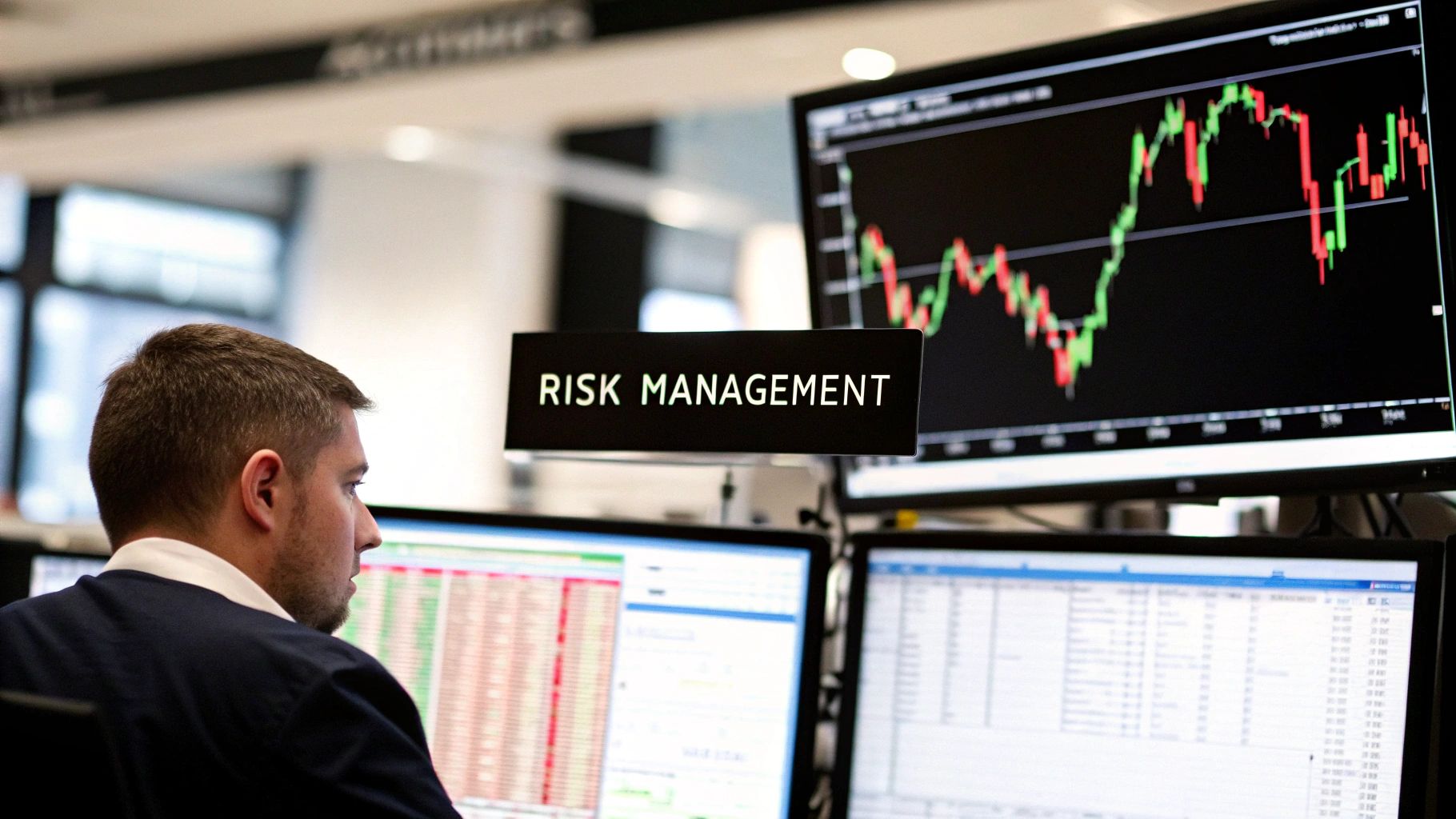
Day trading risk management is the rulebook you create to protect your capital from devastating losses. Since 2014, Trading Made Easy has been dedicated to a single mission: empowering traders with tools that enforce discipline and turn strategy into consistent results. We believe that managing risk isn't just a defensive tactic—it's the very foundation of a long-term trading career. The goal is to ensure no single trade can blow up your account by controlling position sizes, setting intelligent stop-losses, and maintaining a positive risk-to-reward ratio. This discipline is what separates the pros from the 90% who don't make it.
Confronting The Realities Of Day Trading Risk
At Trading Made Easy, we've been in the trenches with traders since 2014, building tools for the real world, not a textbook. A frank discussion about risk has to start with a hard truth: most traders don't fail because they can't find winning trades. They fail because a few massive, uncontrolled losses wipe out all their hard-earned progress and shatter their confidence.
I'm not saying this to scare you off. On the contrary, really understanding the odds is the first step to building the mindset of a professional. It's easy to get mesmerized by the allure of quick profits, but that often blinds people to the disciplined habits that actually lead to long-term success.
Why Most Traders Fail
It's almost predictable. New traders constantly stumble into the same psychological traps. They’ll hang onto a losing trade way too long, just hoping it will bounce back. Or worse, they'll double down on a bad position, desperately trying to claw their way back to breakeven. These are emotional decisions, and they are exactly why a bulletproof risk management plan is non-negotiable.
A solid risk management plan isn't just a safety net—it's the very foundation of a sustainable trading career. It shifts your focus from chasing wins to systematically protecting what you have.
The numbers don't lie, and they paint a pretty bleak picture. A staggering 40% of new day traders throw in the towel within the first month. After three years? Only 13% are still at it. That massive dropout rate tells you everything you need to know about the pressure of managing market volatility.
And yet, the appeal is stronger than ever. The slice of American stock traders who day trade jumped from 15% in 2019 to 25% in 2021. With more people jumping in, the need for rock-solid risk management has never been more critical. You can dig into more of these day trading statistics on highstrike.com.
Adopting A Professional Mindset
If you want to beat those odds, you have to start treating your trading like a business, not a trip to the casino. This is a complete mental shift.
- Focus on Process, Not Profit: Successful traders are obsessed with executing their strategy perfectly. They know that if they stick to their process, the profits will naturally follow.
- Embrace Small Losses: Think of small, controlled losses as a business expense. They're simply the cost of doing business while you hunt for those big opportunities.
- Eliminate Emotional Decisions: Your own psychology is your biggest opponent. Fear and greed are powerful forces that will tempt you to abandon your plan at the worst possible moments.
This is exactly where automated tools become so crucial. Since we started Trading Made Easy back in 2014, our entire focus has been on building software that enforces discipline. Our platform can automatically apply rules like a maximum daily loss limit or ensure every trade has a stop-loss. It acts as your unemotional partner, protecting you from your own worst impulses when the pressure is on.
Calculating Position Size Like A Professional
Solid risk management starts long before you click the "buy" button. It’s all about a cool-headed, disciplined calculation that tells you exactly how much capital to put into a single trade. This isn't about gut feelings or hunches; it’s a crucial framework that shields your account from that one catastrophic loss.
You’ve probably heard of the generic “1% rule,” and it's a decent starting point. But the pros take it a step further. We calculate our position size based on three very specific things: your total account balance, how much you're willing to risk (that 1%), and the unique volatility of the stock you're watching.
A high-flying tech stock that swings wildly needs a completely different approach than a stable blue-chip, and your position size has to reflect that reality.
The Core Formula for Sizing
The whole point is to make sure that if your trade hits its stop-loss, the damage is just a small, pre-planned dent in your capital. Nothing more.
The formula itself is pretty simple:
Position Size = (Account Balance x Risk Percentage) / (Entry Price – Stop-Loss Price)
Let's walk through it. Say you're working with a $25,000 account and you've committed to risking no more than 1% per trade. That's a $250 maximum loss.
You spot a setup in a stock trading at $50. After looking at the chart, you decide a logical stop-loss is at $48.50. The distance you're giving the trade to work is $1.50 per share.
Plugging that into the formula:
Position Size = $250 / $1.50 = 166 shares
By buying 166 shares, you've engineered the trade. If you get stopped out, you lose exactly the $250 you were okay with risking. This mechanical process yanks emotion out of the equation and forces you to be disciplined.
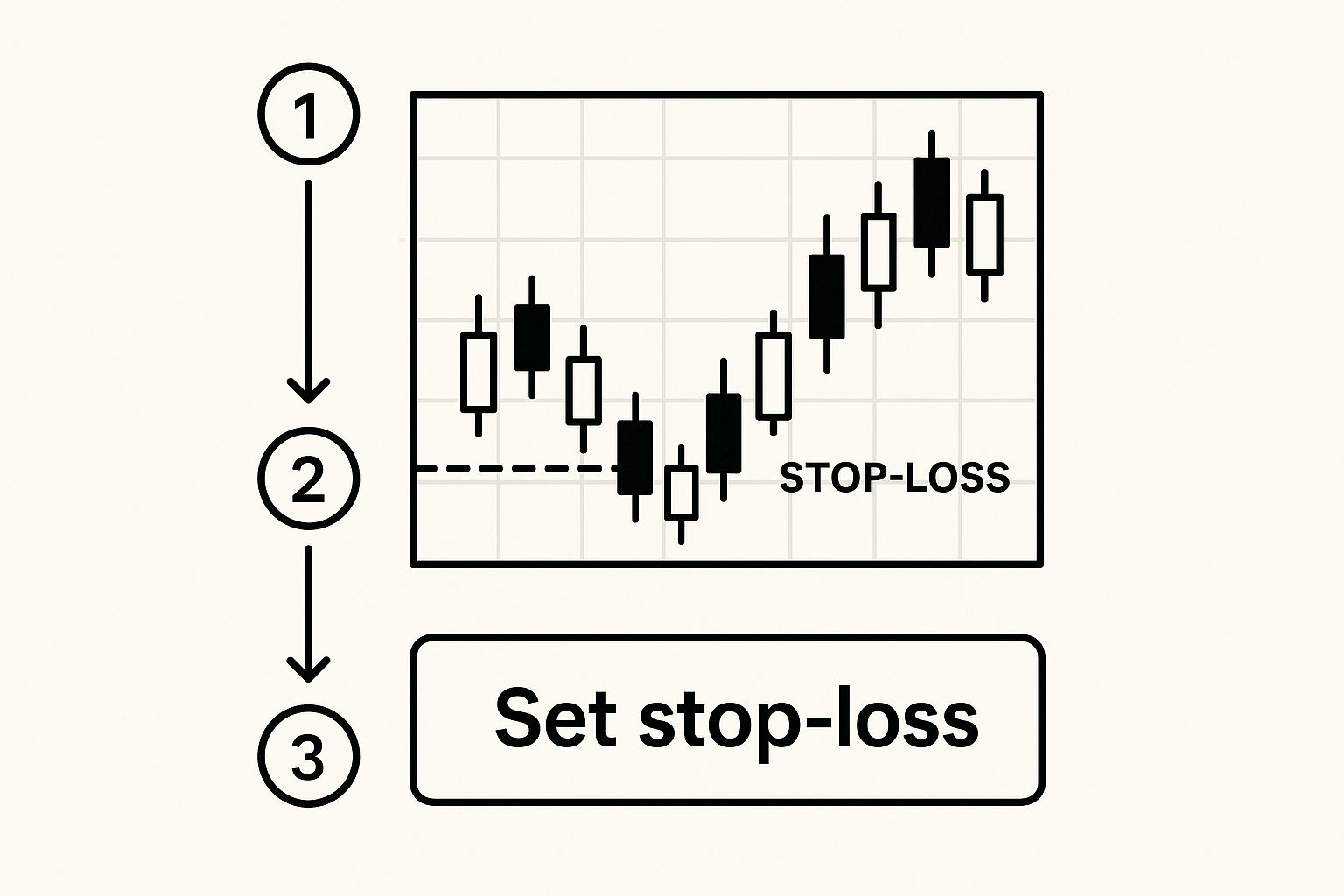
Seriously, mapping out your stop-loss on the chart before you even think about position size is a fundamental habit of disciplined traders.
Making Position Sizing Consistent
This table shows how your position size changes based on stop-loss distance, even with the same account and risk percentage. A wider stop on a volatile stock means you have to buy fewer shares to keep the dollar risk identical.
Risk-Based Position Sizing Scenarios
| Variable | Scenario A (Volatile Stock) | Scenario B (Stable Stock) |
|---|---|---|
| Account Balance | $25,000 | $25,000 |
| Risk per Trade | 1% ($250) | 1% ($250) |
| Entry Price | $50.00 | $50.00 |
| Stop-Loss Price | $48.00 (wider stop) | $49.25 (tighter stop) |
| Risk per Share | $2.00 | $0.75 |
| Calculated Position Size | 125 shares | 333 shares |
Notice how you can trade more than double the shares in Scenario B simply because the stop-loss is tighter, all while keeping your potential dollar loss capped at the same $250.
Automating for Consistency
Doing these calculations for every single trade is critical, but let's be honest—it can be a pain, especially when the market is moving fast and you're feeling the pressure. It’s easy to make a mistake.
This is where automation becomes your best friend. A tool like Trading Made Easy is built to do these vital risk calculations for you, instantly and without any emotional bias.
By automating position sizing, you eliminate the temptation to "bet big" after a win or oversize a position out of frustration. The software becomes your unemotional partner, enforcing your risk plan on every single trade.
This disciplined approach isn't just about math; it's a huge part of your trading mindset. Keeping that control is what keeps you in the game long-term. For a deeper dive into the mental habits that separate winning traders from the rest, check out our guide on day trading psychology. When you pair precise calculations with a tough mindset, you’re building a real foundation for a trading career.
Setting Stop-Losses That Protect and Perform
Your stop-loss is the ultimate safety net in day trading, but get the placement wrong, and it can do more harm than good.
Set it too tight, and you'll get shaken out of perfectly good trades by normal market chop. Set it too wide, and you're taking on way more risk than you need to, which defeats the whole point. The real art is finding that sweet spot—the place where your trade has room to breathe, but your capital is locked down and protected.
This means you have to stop thinking in terms of arbitrary percentages. Instead, let the market’s own structure be your guide. An intelligent stop-loss is based on what the chart is telling you, not some random number you pulled out of thin air.
Methods for Smarter Stop-Loss Placement
To set stops that actually work, you need to anchor them to logical price levels. These are the spots on the chart that scream, "Okay, my trade idea was wrong."
Here are a few of my go-to methods:
- Support and Resistance Levels: This is a classic for a reason. Placing your stop just below a key support level for a long trade (or just above resistance for a short) is a solid strategy. If the price breaks through that level, it’s a strong signal that the market sentiment has shifted against you.
- Key Moving Averages: A widely watched moving average, like the 50-day or 200-day, often acts as a dynamic floor or ceiling for price. By placing your stop on the other side of it, you’re giving your trade a clear line in the sand.
- Volatility Indicators: The Average True Range (ATR) is an absolute game-changer here. It measures how much an asset typically moves over a certain period. Setting your stop at a multiple of the ATR (say, 2x ATR below your entry) helps you adapt your risk to the market's current volatility. It's not one-size-fits-all; it's tailored to what's happening right now.
A well-placed stop-loss is a decision you make when you are calm and analytical. It's an unemotional contract with yourself to accept a small, manageable loss if the trade doesn't work out as planned.
The Dangers of Unprotected Positions
I can't stress this enough: trading without a stop-loss is one of the fastest ways to blow up your account.
The historical data paints a brutal picture. A massive study of over 6,500 U.S. stocks from 1985 to 2024 found the median maximum drawdown—the biggest loss from a peak—was a staggering 85%.
Even worse? About 54% of those stocks never recovered their old high. That’s permanent capital loss. As a day trader, these numbers should be a wake-up call. You absolutely need disciplined stops to avoid getting caught in a catastrophic nosedive.
Protecting Profits with Dynamic Stops
Setting your initial stop is just the beginning. As a trade starts working in your favor, your risk management has to evolve with it.
This is where a trailing stop-loss becomes your best friend. A trailing stop automatically moves up as the price rises, locking in your gains while still giving the trade room to run higher. You could, for instance, set it to trail the price by a fixed dollar amount or a certain percentage.
At Trading Made Easy, our automated tools are built to handle these dynamic strategies perfectly. You can program the system to manage your stops for you, which completely removes the temptation to second-guess your plan or let a winning trade turn into a loser.
As you get more comfortable with these ideas, you might also find value in our comparison of the best AI trading platforms. Many of them feature sophisticated automation for stop-losses, letting you focus on what really matters: finding your next great trade, knowing your capital is being protected.
Using Risk-Reward Ratios For Smarter Trade Selection
https://www.youtube.com/embed/olcP-kewIeE
Let's get one thing straight: long-term success in day trading has almost nothing to do with your win rate.
It all comes down to a powerful concept called positive expectancy. This is just a fancy way of saying your winning trades need to be significantly larger than your losing ones. This is exactly why mastering the risk-to-reward ratio is a non-negotiable part of your trading plan.
It gives you a clear, logical way to look at every potential trade. It forces you to ask the single most important question: "Is the potential upside here really worth the cash I'm about to put on the line?" By systematically ignoring low-reward setups, you start to stack the mathematical odds in your favor.
The Math of Profitability
Think of it this way. A 1:1 risk-to-reward ratio means you’re risking $100 to potentially make $100. With those odds, you have to be right more than 50% of the time just to break even, and that’s before commissions. That's a tough, uphill battle.
Now, let’s look at a trade with a 1:3 ratio. You're still risking that same $100, but your profit target is $300. Suddenly, you can be wrong twice, win just once, and still walk away with a profit. This is how pros build resilience into their strategies—they don't need perfection to be profitable.
The hard truth is that profitability is never a given, even when the market is flying high. Focusing on a solid risk-reward ratio ensures you're not just winning trades, but winning the trades that actually move the needle.
This isn't just theory; it's a lesson backed by painful history. A study of traders during the 1998-1999 internet bubble—one of the hottest bull markets ever—found that over 64% of day traders still lost money.
Even with the Nasdaq soaring, only 36% came out ahead. This just hammers home how critical disciplined risk management is. You can dig into more of these findings on day trader performance for yourself.
Making It Practical
So, how do you apply this? It's pretty straightforward. Before you even think about clicking the "buy" button, you need to know three numbers:
- Your Entry Price: The exact price where you plan to get in.
- Your Stop-Loss: Your pre-defined exit if the trade turns against you (your risk).
- Your Profit Target: A realistic price where you’ll cash out (your reward).
At Trading Made Easy, we built our platform's analysis tools to make this process almost automatic. I’ve personally seen countless traders completely turn their performance around simply by using our software to filter for high-quality setups that meet their risk-reward rules.
Since 2014, our entire mission has been to give traders the tools to enforce this kind of discipline. It’s all about taking emotion out of the equation and focusing only on trades that give you a clear mathematical edge.
How Automation Builds Trading Discipline
Let’s be honest: human emotion is the single biggest enemy of a solid risk management plan. Fear makes you panic and sell a winner way too early. Greed whispers in your ear to hold onto a loser, convinced it’ll turn around. It’s a battle every trader fights.
This is exactly where technology comes in. It acts as your perfectly disciplined, unemotional trading partner.
Here at Trading Made Easy, we’ve been building tools since 2014 to help traders conquer these exact psychological hurdles. Our automated day trading software is designed to take your strategy and execute it with robotic precision. It ensures the smart rules you make with a calm, clear head are the only rules that get followed when the market is going haywire.

Your Unemotional Trading Partner
The magic of automation is its ability to rip emotional decision-making right out of the equation. When you're watching a trade tick by tick, it’s almost impossible not to get sucked into the price action. Our software doesn't feel that anxiety or excitement; it just follows orders.
That means if you set a hard stop-loss, the system exits the trade at that exact price. No second-guessing. No "I'll just give it a little more breathing room" moments—the very mistake that has blown up countless trading accounts.
When you automate the mechanics of trading—like setting stops and calculating your position size—you free up your mental energy to focus on what you, the human, do best: reading the market and finding great setups.
This is a fundamental shift in how you operate. You go from being a reactive trader tossed around by the market's emotional waves to a strategic manager who lets technology handle the grunt work of disciplined execution.
Key Features for Automated Risk Management
Our platform isn't just about placing trades faster. It’s packed with specific safeguards designed to enforce your risk management rules and build unbreakable consistency. These aren't just nice-to-haves; they are your account's bodyguards.
- Automated Stop-Loss Enforcement: Our software can require a predefined stop-loss before any trade is executed. This feature makes it impossible to enter a position without a safety net, eliminating one of the most common and dangerous trading errors.
- Automatic Position Sizing: Based on your account balance and chosen risk percentage, the platform instantly calculates the correct position size for any trade. This ensures your risk remains consistent and prevents costly emotional decisions to oversize a position.
- Daily Loss Limits: Set a maximum dollar amount you're willing to lose in a day. If you hit that threshold, the software can automatically halt your trading. This acts as a crucial circuit breaker, preventing "revenge trading" from wiping out your account.
These automated rules do more than just prevent disaster. They actively build the disciplined habits you need to survive and thrive in this game long-term. If you want to dig deeper into these systems, our guide on the best algorithmic trading software has more on how they work.
Success Story: The Power of Discipline
One of our clients, a talented analyst we'll call Sarah, consistently identified great trade setups but struggled with emotional execution. She would often abandon her stop-losses or double down on losing trades, leading to a volatile equity curve with crushing drawdowns.
After implementing Trading Made Easy, Sarah set two hard rules in the software: a 1% max risk per trade and a 3% max daily loss limit. The change was transformative. The software became her unemotional trading partner, executing her plan flawlessly. Her catastrophic losses vanished. Within a few months, her small, managed losses were consistently outweighed by her well-executed wins, leading to her first period of sustained profitability. Her story is a testament to how our tools don't just execute trades; they build the discipline necessary for success.
Let's Answer Your Top Questions on Day Trading Risk
To wrap things up, let's hit a few of the most common questions I hear from traders trying to get a handle on risk. Think of these as the core ideas to keep in your back pocket.
What’s the Single Most Important Risk Rule for a New Trader?
Easy. Never, ever risk more than 1% of your trading capital on a single trade.
If you’re working with a $25,000 account, that means your absolute maximum loss on any one position is $250. This isn't just a guideline; it's the foundation of your entire trading career. Sticking to it is what separates the pros from the gamblers.
This rule keeps you in the game. You will have losing streaks—everyone does. The 1% rule ensures you can take those hits, learn from them, and still have the capital to be there when the great setups finally appear.
How Does Automation Actually Help With Risk Management?
Look, your biggest enemy in trading is often the person staring back at you in the mirror. Automation, like the tools we built at Trading Made Easy, basically takes your emotional, impulsive self out of the driver's seat.
When the market gets wild, fear and greed start screaming in your ear, telling you to ditch the plan. An automated system is your disciplined co-pilot. It just follows the rules.
- It calculates your position size instantly based on your 1% rule. No guesswork.
- It can require a stop-loss to be in place before you can even enter a trade.
- It enforces your daily loss limit, shutting you down before you can start "revenge trading" your account to zero.
It handles all the mechanical stuff, making sure you stick to the smart, logical plan you made when you were calm and thinking clearly.
When Should I Move My Stop-Loss During a Live Trade?
This is critical. You should never move your stop-loss further away from your entry price. Period. Widening your stop to "give the trade more room" is a classic mistake driven by hope, and it's how small, manageable losses turn into account-crippling disasters.
The only time you should move your stop is to protect your profits. A great technique is to slide your stop-loss up to your entry price (break-even) once the trade has moved a good distance in your favor. This instantly turns the position into a risk-free opportunity to let a winner run.
Mastering day trading risk management is the difference between a short-lived hobby and a sustainable career. It requires calculating position size professionally, setting intelligent stops, and demanding a positive risk-to-reward ratio on every trade. As we've seen, human emotion is the greatest obstacle to this discipline. Since 2014, Trading Made Easy has been dedicated to providing automated tools that enforce your rules, remove emotion, and build the consistency required for long-term success. Discover how our software can become your unemotional trading partner by visiting us at https://tradingmadeasy.com.
Leave a Reply