So, you're ready to get into automated trading. Smart move. But picking the right software is the first big hurdle, and it’s a decision you have to get right. It’s less about finding a product and more about finding a true partner for your financial strategy—one that acts with the speed and discipline you need.
Your Guide to Selecting the Right Trading Software
Since 2014, Trading Made Easy has been dedicated to a single mission: cutting through the complexity of the trading world and providing traders with powerful, accessible tools that deliver real results. We’ve seen firsthand how the right technology can level the playing field.
This guide is designed to help you look past the slick marketing and focus on what really matters. We'll dig into the critical features that drive performance, show you how to test a platform’s reliability, and explain why rock-solid risk controls are something you should never compromise on. This is your checklist for making a choice that fits your trading style and your goals.
Our Mission and Unique Features
At Trading Made Easy, our entire focus is on making automated day trading not just possible, but genuinely effective for regular people. We built our patented, AI-driven software to take one thing out of the equation: emotion. That’s what trips up most manual traders.
Our unique software offers several key benefits. It automates pre-set strategies and can execute trades up to 1,000 times faster than a human ever could, allowing it to capitalize on opportunities that are gone in the blink of an eye. This speed and precision, especially in choppy markets, gives our traders a significant edge. Furthermore, by letting the software run your strategy, you sidestep the fear and greed that can wreck a perfectly good plan. Finally, we've integrated advanced safety nets directly into the software, because protecting your capital is a non-negotiable part of our philosophy.
Success Stories That Inspire
The real proof of our software's value is in the results our users achieve. We've seen people from all backgrounds completely transform their trading by leveraging our technology.
Take John Carter, a retired Green Beret, for example. He has reported a consistent success rate of up to 95% since implementing our system. He attributes this success to the automation, which removed the emotional second-guessing and allowed him to trust his strategy to perform optimally. Another user, a busy professional, successfully runs a futures trading strategy while managing a demanding full-time job. The platform’s “set-and-forget” capability means he can remain active in the market without being glued to his screen all day. These stories highlight what happens when a solid strategy is powered by robust technology.
Your Next Step in Automated Trading
Choosing your software is a huge decision. It sets the tone for your entire trading experience. You're not just looking for cool tech; you need a platform that comes with solid support and a clear, simple path to get you started.
We're all about empowering our users with the right tools and the knowledge to use them. Think of this guide as your starting point to cut through the noise, make a confident choice, and set yourself up for a more disciplined trading career.
Decoding the Features of Winning Trading Platforms
When you first start shopping for the best algorithmic trading software, the wall of features can be a real headache. Every platform throws buzzwords at you, promising the moon. But from my experience, the truly great platforms are the ones that pair serious firepower with a clean, intuitive interface. A winning platform isn't just a tool to place trades; it becomes a natural extension of your strategy.
At the heart of any solid system is its backtesting engine. I'm not talking about a quick, glossy simulation. A robust backtester lets you stress-test your strategy against high-quality historical data, showing you exactly how your algorithm would have held up through bull markets, bear markets, and all the sideways chop in between. This is how you find the flaws before you put real money on the line.
This data-first mindset is why the industry is booming. The global algorithmic trading market was valued at around USD 17.0 billion in 2023 and is on track to hit USD 65.2 billion by 2032. That’s not just hype; it's driven by tech that makes this level of analysis possible. You can discover more insights on the market's trajectory to see what’s fueling this change.
The Power Trio of Algorithmic Features
Beyond a good backtester, I’ve found that the best platforms nail three things: data integration, risk management, and user experience. Think of it like a three-legged stool—if one leg is wobbly, the whole thing comes crashing down.
First up, low-latency data integration is absolutely non-negotiable. In the algo trading world, a few milliseconds can be the difference between profit and loss. You need a platform with a lightning-fast, direct pipeline to market data. Any lag introduces slippage, which can quietly bleed your account dry.
Next, you need customizable risk parameters. This is your automated safety net. A top-tier platform lets you hard-code your discipline by setting things like a max daily loss, position size limits, or automated stop-losses. These aren't just settings; they're the guardrails that protect your capital when the market goes haywire or a strategy starts to misbehave.
Finally, it all comes together with an intuitive user interface (UI). A cluttered, confusing dashboard just gets in your way and invites mistakes. The goal is to focus on your strategy, not on trying to figure out where the developers hid the button you need. The best software makes complex information simple to digest.
The image below really captures how a modern trader uses technology to stay on top of the market.
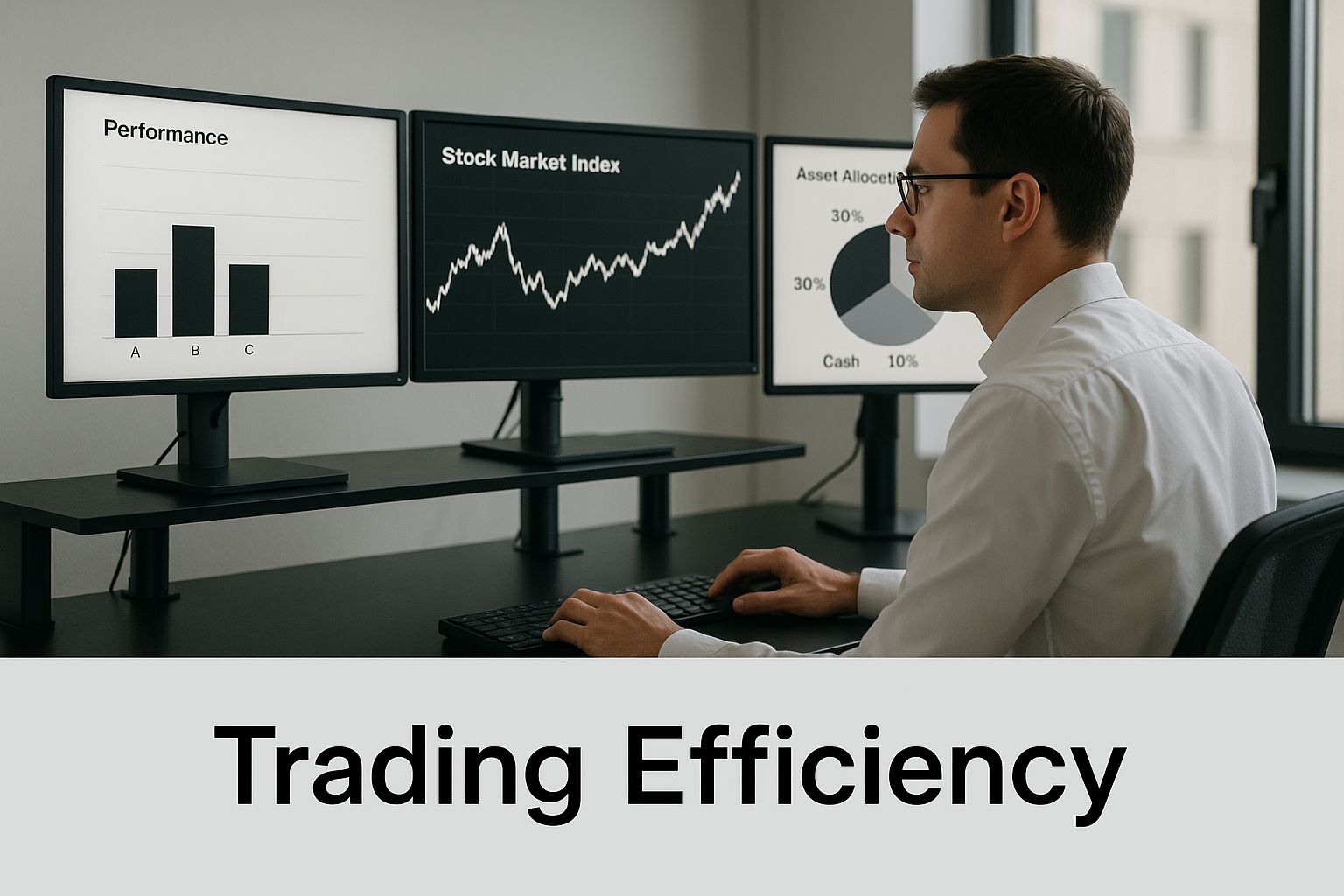
That kind of clean, multi-faceted view is only possible when the software is designed for clarity and control from the ground up.
Distinguishing Must-Haves from Nice-to-Haves
As you look at different options, it helps to separate the absolute essentials from the "nice-to-haves." Some features are critical for getting started, while others are built for advanced quants who need maximum flexibility. Knowing the difference helps you pick a platform that fits you now but still gives you room to grow.
To help you sort through the noise, I’ve put together a checklist. It breaks down the features I see as essential versus those that are more advanced.
Essential Features Checklist for Algorithmic Trading Software
This table compares essential versus advanced features to help you prioritize what matters most in a trading platform.
| Feature Category | Essential for All Traders | Advanced for Serious Traders |
|---|---|---|
| Strategy Development | A visual, no-code strategy builder that allows you to create and modify rules without programming. | API access (e.g., Python, C#) for developing complex, custom-coded algorithms and indicators. |
| Backtesting Engine | Ability to test strategies on historical data with key performance metrics like profit factor and win rate. | High-fidelity, tick-by-tick backtesting that accounts for slippage, commissions, and variable spreads. |
| Risk Management | Basic stop-loss and take-profit orders that can be automated within a strategy. | Dynamic position sizing, portfolio-level drawdown limits, and an emergency "kill switch" to halt all activity. |
| Data & Connectivity | Real-time data feed from your broker and seamless integration for order execution. | Support for multiple data feeds (e.g., equities, futures, forex) and ultra-low latency execution via a VPS. |
This isn't about finding the platform with the longest feature list. It’s about finding the one with the right features for you.
The most effective trading software doesn't just offer a long list of features. It offers the right features, presented in a way that simplifies your workflow and reinforces disciplined trading habits.
Ultimately, the goal is to find a platform that feels like a natural fit for your trading style. It needs to be powerful enough to execute your vision but simple enough that it doesn't become a barrier to your success.
Real Success Stories from the Trading Frontlines
Theories and feature lists are one thing, but the real test of any trading software is how it performs in the hands of actual traders. Since we launched Trading Made Easy back in 2014, our entire focus has been on building tools that get real, tangible results. The goal is to empower traders by taking emotion out of the equation and letting a disciplined, precise platform do the heavy lifting.
The stories below come from real user experiences. They show how our automated day trading software helps people tackle common trading roadblocks and hit their financial goals. These aren't just feel-good anecdotes; they're practical examples of what happens when powerful technology meets a solid strategy.
From Part-Time Trader to Consistent Earner
Take a user we’ll call Mark. He’s a full-time IT professional with a young family who had a solid swing trading strategy for the futures market. The problem? He just didn't have the time to sit and watch charts all day. He was constantly missing perfect entry points or holding positions too long simply because he was stuck in a meeting. It was frustrating and, frankly, costing him money.
Mark decided to automate his existing strategy on our platform. Using our visual strategy builder, he translated his rules—which were based on specific moving average crossovers and RSI levels—into a working algorithm. The best part? He didn't have to write a single line of code.
Here’s exactly how our features helped him turn things around:
- "Set-and-Forget" Automation: Mark could turn his strategy on before heading to the office and let it run. He finally had confidence that trades would be executed exactly as he intended, whether he was watching or not.
- Precise Entry and Exit Points: The software got him in and out at the exact price points his rules dictated. All the slippage and hesitation that came with manual trading disappeared overnight.
- Automated Risk Controls: He implemented a strict daily stop-loss, giving him peace of mind that one bad day would never blow up his account.
In just a few months, Mark went from a stressed-out hobbyist to a consistent earner. His trading became a reliable source of supplemental income, and he no longer had to choose between his career and his passion for the markets.
"The true advantage of automation isn't just speed; it's the freedom it gives you. Our platform allows traders to participate in the market on their terms, without being chained to a screen."
Overcoming Emotional Trading for Scalable Growth
Another great example is a seasoned trader we'll call Sarah. She had years of experience and was already profitable, but she knew her own worst enemy was herself. During volatile market swings, she’d often override her own system, letting fear or greed take the driver's seat. That emotional baggage was holding her back from scaling up her operation.
Sarah came to our software with one main goal: enforce mechanical discipline. By fully automating her strategy, she put a hard, non-negotiable wall between her emotions and her trades. The software became her partner, executing her plan with the unwavering consistency she struggled to maintain on her own.
This simple shift was a game-changer. It allowed her to:
- Trade Multiple Markets Simultaneously: With the system handling all the execution, she could confidently deploy strategies across several different futures markets without feeling overwhelmed.
- Eliminate Costly Errors: The platform executed her plan flawlessly. Revenge trading and taking profits too early—habits that had capped her potential—were gone for good.
- Focus on Strategy Refinement: Instead of micromanaging trades, she could spend her time where it mattered most: analyzing performance data and tweaking her algorithms for even better results.
By stepping away from the execution process, Sarah was finally able to trade her system exactly as she designed it. Her profitability shot up, and just as importantly, her stress levels plummeted. She wasn't fighting the market and herself anymore. She was simply managing a system—the core principle of successful automated trading.
Integrating Your Software Into Your Trading Ecosystem
Alright, so you’ve picked out your best algorithmic trading software. That's a huge step, but the real work starts now: making it play nicely with everything else you're using. The smartest algorithm on the planet is dead in the water if it can't talk to your broker or get clean data.
A smooth integration means your entire system works like a single, well-oiled machine from the get-go.
Think of your new software as the brain of your trading operation. It needs a solid nervous system to connect it to the market, and that’s where things like API connectivity and data feeds come in. They're the critical links that turn your strategy into live trades.
Establishing a Solid Connection
First things first, you have to be absolutely sure the software can communicate with your brokerage account without a hitch. This happens through an Application Programming Interface (API), which is basically a secure digital handshake between the two systems. A rock-solid API connection is non-negotiable if you want fast, reliable order execution.
Before you pull the trigger on any software, double-check these things:
- Direct Broker Support: Does the software have official, native integration with your broker? This is always the most stable and secure route.
- API Stability: Hit the user forums and read reviews. You’re looking for feedback on the connection's reliability. Frequent disconnects or lag can be a total account-killer during live trading.
- Data Feed Compatibility: The software must be able to understand the data feed from your broker or another provider. If the formats don't match, you could see execution errors or messed-up charts.
This need for advanced, interconnected infrastructure is exactly why the market is blowing up. The AI trading platform space was valued at USD 11.26 billion in 2024 and is expected to hit nearly USD 69.95 billion by 2034. That growth is all about demand for powerful, connected systems.
Choosing Your Hosting Environment
Once you’ve got connectivity sorted, you need to decide where your software is going to "live." You've got two main choices: run it on your own computer or host it on a cloud-based Virtual Private Server (VPS). Both have their pros and cons.
Running it locally is easy and doesn't cost extra, but it leaves your trading vulnerable to everyday problems—power outages, internet drops, or even just accidentally restarting your PC. For anyone serious about this, those risks are a hard pass.
A VPS, on the other hand, is a remote computer sitting in a professional data center with backup power and redundant internet. This setup ensures your algorithm can run 24/7 without interruption, which is essential if your strategies are always active.
A VPS is more than just a convenience; it's an insurance policy against the unpredictable technical issues that can happen at home. For any serious automated trader, it’s an essential part of the toolkit.
Let’s break down the choice.
| Aspect | Local Machine (Your PC) | Virtual Private Server (VPS) |
|---|---|---|
| Uptime & Reliability | Depends on your home power and internet. Vulnerable to disruptions. | Near 100% uptime with redundant systems. Ideal for nonstop trading. |
| Latency | Limited by your home internet speed. Can be higher. | Often located in data centers near exchange servers, which cuts down latency. |
| Cost | No extra cost beyond your computer. | Monthly subscription, usually starting around $30-$50. |
| Best For | Beginners, backtesting strategies, or traders running bots only during market hours. | Serious traders, strategies that run 24/7, and anyone who needs maximum reliability. |
Ultimately, integrating your software is all about building a stable and efficient trading ecosystem. By nailing your API connectivity and picking the right hosting, you create a strong foundation for your journey into automated trading. For a deeper look, check out our guide on the core components of automated day trading systems and how they all fit together.
Ready to Start Your Automated Trading Journey?
Picking the right algorithmic trading software isn't just a small decision—it’s the bedrock of your entire trading career. We've gone through the must-have features, how to evaluate performance, and what a stable integration looks like. The key takeaway is that you need a platform that not only offers powerful technology but also aligns with your trading style and provides reliable support.
That’s exactly what we’ve been building at Trading Made Easy since 2014. Our mission is to give traders robust, intuitive tools that remove the emotional element from trading and execute strategies with precision. We are committed to arming you with both the technology and the knowledge to succeed. By summarizing the key points of this guide, we hope to empower you to make an informed decision and encourage you to explore Trading Made Easy’s offerings for a more disciplined and potentially profitable trading future.
What Sets Our Platform Apart
Our software is built around three core pillars: speed, discipline, and security. We use a patented, AI-driven system that puts your strategies on autopilot, executing trades at speeds you could never match manually. You’ll never have to worry about missing a split-second opportunity again. Plus, our built-in risk management tools are always on, acting as a tireless guardian for your capital.
But don't just take our word for it. The proof is in our traders' results. We’ve watched people from every background completely change their trading game by switching to a systematic approach. From a doctor automating a side income to full-time pros scaling their operations, our software provides the framework for consistent, repeatable performance.
Your Path Forward Starts Here
I genuinely invite you to see what Trading Made Easy is all about. Take a deep dive into our automated day trading software and see for yourself how its features can be molded to fit your personal goals. Our team and our library of educational resources are right here to guide you, every step of the way.
It’s time to move forward with confidence. Discover how having the right tools can completely reshape your view of the markets and help you finally hit those financial targets.
Got Questions? We’ve Got Answers.
Diving into automated trading can feel like learning a new language, and it's totally normal to have a few questions. Whether you're trying to figure out where to start or you're a seasoned trader looking for a better toolkit, getting straight answers is critical. Let's tackle some of the most common questions we hear about finding and using the best algorithmic trading software.
Do I Need to Be a Coder to Use This?
That’s probably the biggest myth out there. The short answer is no. We built our software specifically for traders, not programmers. You can build and test incredibly sophisticated strategies using a simple visual editor—no code required. It’s all drag-and-drop.
Now, if you do have a coding background and want to get your hands dirty building custom indicators or more complex systems, we’ve got you covered. Our full-featured API gives you the keys to the kingdom, with support for popular languages like Python.
What Happens When the Market Goes Crazy?
We all know those days. A sudden news event hits, and the market goes haywire. Protecting your capital in those moments is everything. That’s why we’ve built multiple, customizable layers of risk controls right into the platform.
Think of it as a defense-in-depth strategy for your account:
- The Big Red Button: We have emergency kill switches that let you instantly pause all trading with a single click if things get too chaotic.
- Smarter Stop-Losses: Forget static orders. Our dynamic stop-losses can adjust on the fly based on real-time volatility, giving your trades room to move without getting stopped out by a random spike.
- News-Aware Trading: You can set rules to automatically pull back or halt trading around major economic announcements, keeping you out of the most unpredictable moments.
It's all about building a system that can navigate rough waters safely and systematically, not just sunny skies.
Can I Hook This Up to My Own Broker?
Absolutely. Smooth, reliable integration is a must-have. We connect directly with a long list of major brokers through their official APIs. This isn't some clunky workaround; it's a stable, low-latency connection built for performance. You can check out the full list of our supported partners in our official documentation.
We’re always adding more brokers based on what our users ask for. And if yours isn't on the native list yet, we often have other ways to connect, so you're rarely left out.
Backtesting is a phenomenal tool for stress-testing a strategy's logic, but it’s not a crystal ball. Its real job is to show you how a system would have performed in the past, not to promise future profits.
Our platform uses high-quality, tick-level historical data to give you an incredibly realistic simulation. But we always tell traders to follow up backtesting with forward-testing on a demo account. It’s the best way to get a complete picture of how a strategy might actually hold up in a live, unpredictable market.
Ready to trade with confidence and precision? Join the thousands of traders who have transformed their approach with Trading Made Easy. Explore our patented, AI-driven day trading platform and see how automation can help you reach your goals.
Leave a Reply